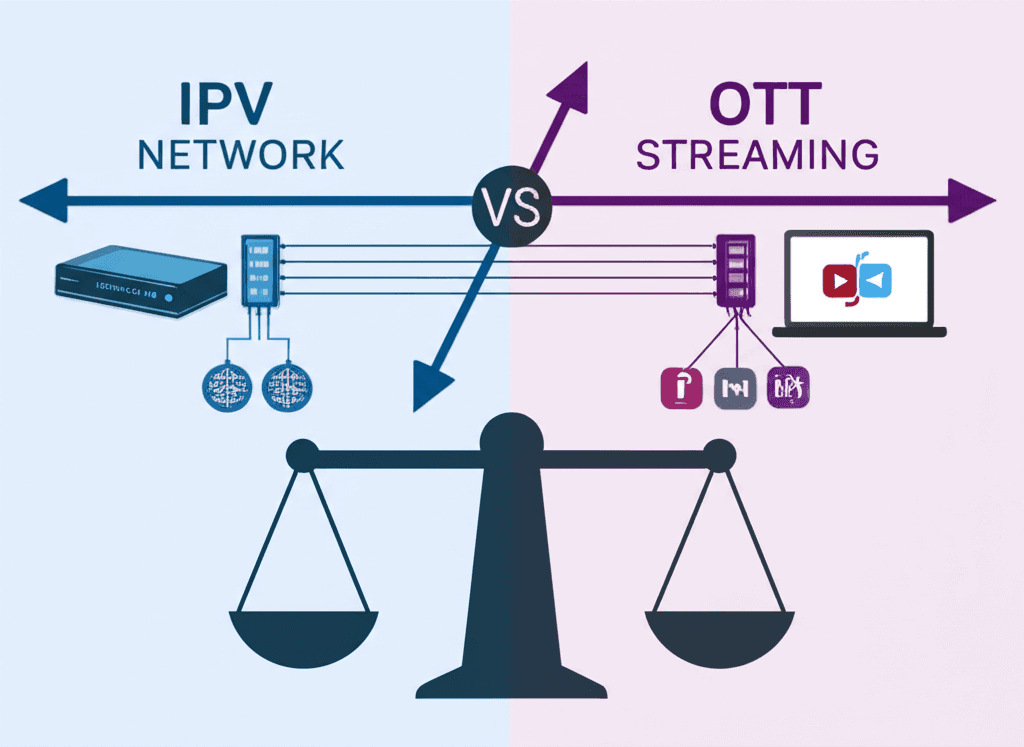
The Streaming Technology Landscape
The terms IPTV and OTT are often used interchangeably, but they represent fundamentally different approaches to delivering video content over networks. Understanding these differences helps viewers make informed choices about their streaming services and explains why certain services perform differently under various conditions.
Both technologies deliver television and video content over internet protocols rather than traditional broadcast methods like antenna, cable, or satellite. However, the network infrastructure, delivery mechanisms, and resulting user experience differ significantly. This guide explores these differences in depth, examining technical architecture, practical implications, and how the industry is evolving.
What is IPTV (Internet Protocol Television)?
IPTV, in its traditional definition, refers to television content delivered over a managed, private network infrastructure. This is typically provided by telecommunications companies (telcos) or internet service providers (ISPs) as part of bundled services. The key characteristic is that IPTV operates on a closed, dedicated network with quality of service (QoS) guarantees.
Technical Characteristics of Managed IPTV
- 1.Dedicated Bandwidth: Traffic flows over a separate network segment from regular internet traffic, ensuring video streams always have sufficient bandwidth.
- 2.Quality of Service (QoS): Network prioritization ensures IPTV packets receive preferential treatment, reducing latency and packet loss.
- 3.Multicast Delivery: Live channels use multicast, where one stream serves all viewers on the network watching that channel, reducing bandwidth requirements.
- 4.Set-Top Box Requirement: Traditional IPTV often requires provider-specific hardware (set-top boxes) that connect to the managed network.
- 5.Geographic Limitation: Only available within the provider's network footprint since it requires their managed infrastructure.
Examples of traditional managed IPTV include AT&T U-verse (now largely migrated to OTT), Verizon FiOS TV, and various telco TV services worldwide. These services guarantee picture quality because the network is engineered specifically for video delivery.
What is OTT (Over-The-Top)?
OTT services deliver content "over the top" of existing internet infrastructure, without requiring special network arrangements with ISPs. The content travels over the public internet, competing with all other traffic for bandwidth. This approach offers greater flexibility and reach but without guaranteed quality of service.
Technical Characteristics of OTT
- 1.Public Internet Delivery: Content travels over standard internet connections alongside all other web traffic.
- 2.Adaptive Bitrate Streaming: Quality adjusts dynamically based on available bandwidth, potentially varying during viewing.
- 3.Unicast Delivery: Each viewer receives their own individual stream, requiring more aggregate bandwidth for popular content.
- 4.Device Flexibility: Works on any device with a compatible app - smart TVs, streaming devices, phones, tablets, computers.
- 5.Global Accessibility: Available anywhere with internet access (subject to geo-restrictions based on content licensing).
Examples of OTT services include Netflix, Hulu, Disney+, Amazon Prime Video, YouTube TV, and most streaming services consumers interact with daily. These services rely on content delivery networks (CDNs) to distribute content globally and adaptive streaming to handle variable network conditions.
Head-to-Head Comparison
| Characteristic | Managed IPTV | OTT |
|---|---|---|
| Network | Dedicated/managed | Public internet |
| Quality Guarantee | Yes (QoS) | No (best effort) |
| Device Requirements | Often specific hardware | Any compatible device |
| Geographic Availability | Provider's footprint only | Global (with geo-restrictions) |
| Live TV Latency | Very low (seconds) | Higher (10-60 seconds typical) |
| Channel Switching | Fast (under 1 second) | Slower (2-5 seconds) |
| Cost Structure | Bundled with ISP service | Separate subscription |
| Portability | Limited to home network | Anywhere with internet |
The Blurring Lines: Modern Reality
In practice, the distinction between IPTV and OTT has become increasingly blurred. Many services that consumers call "IPTV" are technically OTT services delivering content over the public internet. The term IPTV has evolved in common usage to encompass various internet-based TV services, regardless of whether they use managed networks.
Traditional telco IPTV providers have largely migrated to OTT delivery models. AT&T transitioned U-verse customers to their AT&T TV (now DirecTV Stream) OTT platform. This shift reflects the practical advantages of OTT: lower infrastructure costs, device flexibility, and the ability to reach customers outside their wired network footprint.
Meanwhile, OTT services have evolved to offer features once exclusive to managed IPTV: multi-channel packages, DVR functionality, EPG guides, and live TV. Services like YouTube TV, Hulu + Live TV, and Sling TV demonstrate that OTT can replicate the traditional TV experience.
Quality Considerations in Practice
The theoretical quality advantages of managed IPTV matter less as internet infrastructure improves. With modern broadband connections, OTT services routinely deliver excellent quality. Key factors determining quality include:
What Affects OTT Quality
- 1.Overall internet speed and stability
- 2.Other household internet usage
- 3.WiFi quality vs wired connection
- 4.ISP network congestion
- 5.CDN performance and proximity
OTT Quality Optimization
- 1.Use wired ethernet when possible
- 2.Upgrade to faster internet plans
- 3.Enable QoS on home router
- 4.Use 5GHz WiFi band for streaming
- 5.Choose providers with good CDN coverage
Live TV: Where Differences Matter Most
The distinction between IPTV and OTT becomes most apparent with live television, particularly sports. Managed IPTV typically offers lower latency, meaning you see events nearly in real-time. OTT live streams often have 20-60 second delays due to buffer requirements for adaptive streaming.
This latency matters when watching sports - your neighbor with cable or managed IPTV might cheer for a goal while you're still watching the play develop. Social media spoilers become an issue. However, low-latency streaming protocols are improving OTT live performance, with some services now achieving sub-10 second delays.
Channel switching speed also differs. Managed IPTV with multicast can switch channels almost instantly since all channels are already being broadcast on the network. OTT requires establishing a new connection for each channel change, typically taking 2-5 seconds. This affects the traditional "channel surfing" experience.
Cost and Value Comparison
Traditional managed IPTV is typically bundled with internet service, making direct price comparison difficult. OTT services offer more transparent, standalone pricing. Consider these factors:
Managed IPTV: Often requires a bundle commitment with internet service. Monthly costs may appear lower but require minimum contract terms. Equipment rental fees for set-top boxes add to monthly costs. Limited competition since only one provider serves most areas.
OTT Services: Flexible month-to-month subscriptions with easy cancellation. No special equipment required - use devices you already own. Multiple competing services allow price shopping. Can be combined with any internet provider.
The OTT model generally offers more flexibility and consumer choice, while managed IPTV may provide better quality guarantees for those who value consistent performance over flexibility.
The Future: Convergence and Evolution
The industry is clearly moving toward OTT delivery as the dominant model. Several trends support this:
Improved Internet Infrastructure: As fiber and high-speed cable become more widespread, the quality advantages of managed IPTV diminish. Most households can now reliably stream 4K content over OTT.
5G and Fixed Wireless: New wireless technologies bring high-speed internet to areas without wired infrastructure, expanding OTT reach while bypassing traditional telco IPTV infrastructure entirely.
Protocol Improvements: Low-latency streaming protocols (LL-HLS, CMAF) are closing the live-TV performance gap between OTT and managed IPTV.
Consumer Preference: Viewers increasingly prefer the flexibility of OTT - watching on any device, anywhere, without special equipment or long-term contracts.
Making Your Choice
For most consumers in 2026, the IPTV vs OTT distinction is largely academic. The practical question is which service offers the content you want at a price you're willing to pay. Most viewers will choose among various OTT options, as traditional managed IPTV is either unavailable or being phased out in their area.
If you have access to traditional managed IPTV through your ISP and value guaranteed quality, especially for live sports, it may be worth considering. However, for most users, the flexibility, price competition, and improving quality of OTT services make them the practical choice.