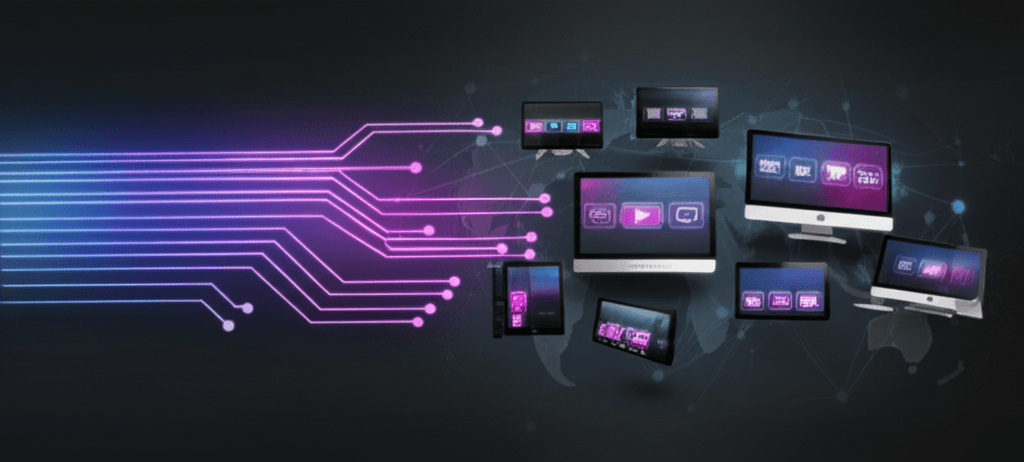
Understanding IPTV Technology
Internet Protocol Television (IPTV) represents a fundamental shift in how television content reaches viewers. Unlike traditional broadcasting methods that transmit signals through satellite dishes, cable connections, or terrestrial antennas, IPTV delivers television programming through the same packet-switched networks that power the internet. This distinction enables capabilities impossible with conventional broadcast systems while creating new possibilities for interactive and personalized viewing experiences.
The technology emerged from the convergence of telecommunications and broadcast industries as internet infrastructure became capable of handling high-bandwidth video streams. Early experiments with video over IP networks date back to the 1990s, but widespread commercial deployment began in the mid-2000s when DSL and fiber optic connections achieved the speeds necessary for reliable television delivery. Today, IPTV encompasses everything from telecom operator services to independent streaming platforms.
At its core, IPTV transmits video content as a stream of IP packets—the same fundamental units that carry web pages, emails, and other internet data. This approach allows television signals to travel over existing network infrastructure alongside other data types, eliminating the need for dedicated broadcast frequencies or physical cable installations. The same internet connection that enables web browsing and video calls can deliver hundreds of television channels simultaneously.
How IPTV Works
The IPTV delivery chain begins at content sources—broadcast feeds, production studios, or content aggregators—where video signals are captured and prepared for internet transmission. This preparation involves encoding the video into digital formats suitable for network delivery, typically using compression standards like H.264 (AVC) or H.265 (HEVC) that reduce file sizes while maintaining visual quality.
Encoded content travels to IPTV headend systems that function as the central distribution hub. These systems organize programming into channel lineups, manage encryption and access control, and prepare content for delivery to subscribers. Modern headends utilize content delivery networks (CDNs)—geographically distributed server networks that position content closer to viewers, reducing latency and improving reliability.
When viewers request content—by selecting a channel or program—their device communicates with IPTV servers to initiate a stream. For live television, this stream represents a continuous flow of video data in real-time. For on-demand content, servers deliver specific files when requested. The viewer's device decodes incoming data packets and displays the video, typically with minimal perceptible delay from the original broadcast.
IPTV Delivery Methods
- • Unicast: Individual stream for each viewer, used for on-demand content
- • Multicast: Single stream shared by multiple viewers, efficient for live TV
- • Broadcast: Signal sent to all subscribers simultaneously
- • Adaptive Bitrate: Quality adjusts based on network conditions
Types of IPTV Services
IPTV services typically offer content across three main categories, each serving different viewing needs and technical requirements. Understanding these categories helps users evaluate services and set appropriate expectations for what different offerings provide.
Live Television
Live IPTV mirrors traditional broadcast television, delivering content as it airs in real-time. News broadcasts, sports events, and scheduled programming arrive at viewer screens with minimal delay from the actual broadcast. This synchronicity matters particularly for live events where viewers want to experience moments as they happen rather than after social media reveals outcomes.
Live IPTV channels typically utilize multicast delivery within managed networks or adaptive streaming over the public internet. Multicast efficiency comes from sending a single stream that network equipment replicates to multiple viewers, while adaptive streaming creates individual connections but adjusts quality dynamically based on each viewer's bandwidth availability.
Time-Shifted Television
Time-shifted services allow viewers to watch previously broadcast content at their convenience. Catch-up TV provides access to programs that aired recently—typically the past 24-72 hours or up to a week—without requiring users to have recorded them. Start-over features let viewers restart programs already in progress from the beginning, useful when joining a movie or show midway through.
Cloud DVR functionality extends time-shifting capabilities by allowing users to schedule recordings of upcoming programs. Unlike traditional DVR boxes with limited storage, cloud-based recording stores content on remote servers with potentially unlimited capacity. This approach eliminates hardware constraints while enabling access to recordings from any authorized device.
Video on Demand (VOD)
Video on Demand libraries offer movies, series, and other content available whenever viewers choose to watch. Unlike scheduled programming, VOD content sits on servers ready for immediate playback upon request. This category most closely resembles services like Netflix or Amazon Prime Video, though IPTV providers often bundle VOD alongside live channels rather than offering it as a standalone service.
VOD libraries vary dramatically in size and freshness across providers. Some services offer tens of thousands of titles including recently released content, while others maintain smaller catalogs of older programming. The quality and organization of VOD libraries—including search functionality, categorization, and metadata accuracy—significantly impact user experience.
IPTV vs Traditional Television
Comparing IPTV with traditional television delivery methods reveals distinct advantages and limitations for each approach. Cable and satellite systems have decades of refinement and widespread infrastructure, while IPTV offers flexibility and features that traditional methods cannot easily replicate.
Comparison: IPTV vs Cable/Satellite
| Feature | IPTV | Cable/Satellite |
|---|---|---|
| Delivery Method | Internet connection | Dedicated infrastructure |
| Device Flexibility | Any internet device | Provider equipment |
| Interactive Features | Full two-way capability | Limited or one-way |
| Installation | Self-install via app | Professional installation |
| Weather Dependency | Minimal (wired internet) | Satellite affected by storms |
Technical Requirements
Successful IPTV viewing depends on meeting certain technical requirements, with internet connectivity representing the most critical factor. Unlike traditional television where signal quality depends on antenna positioning or cable condition, IPTV quality correlates directly with available bandwidth and connection stability.
Bandwidth requirements scale with desired video quality. Standard definition content requires only 3-5 Mbps, accessible to even basic internet connections. High definition programming needs 10-15 Mbps, while Full HD (1080p) demands 15-25 Mbps for smooth playback. Ultra HD 4K content pushes requirements to 25-50 Mbps, though efficient HEVC encoding can reduce these figures somewhat.
Connection stability matters as much as raw speed for IPTV. A connection fluctuating between 5 and 50 Mbps may perform worse than a steady 15 Mbps connection because live streaming cannot buffer ahead indefinitely like on-demand content. Latency (delay) and jitter (variation in delay) affect channel switching speed and can cause audio-video synchronization issues.
The Evolution of Television
IPTV represents one stage in television's ongoing evolution from broadcast scarcity to content abundance. Early television offered handful of channels determined entirely by broadcasters; viewers watched what networks chose to air, when networks chose to air it. Cable expanded options but maintained the scheduled programming paradigm. IPTV and streaming fundamentally shift control toward viewers, who increasingly expect content available on their terms.
The technology continues advancing alongside broader internet capabilities. Improved compression standards reduce bandwidth requirements while maintaining quality. Edge computing brings content processing closer to viewers, reducing latency. 5G mobile networks promise IPTV-quality streaming without wired connections. These developments suggest IPTV will become increasingly capable and accessible as underlying infrastructure improves.
Understanding IPTV technology provides foundation for evaluating services, troubleshooting problems, and anticipating how television consumption will continue evolving. Whether delivered by telecom operators, independent providers, or hybrid services, IPTV represents the present and future of how most people will experience television content.